Roberto Rizzato, PhD
Lichtenbergstraße 4, 85748 Garching bei München
Abstract
Optically addressable spin defects in wide-bandgap semiconductors have become a cornerstone of quantum sensing and metrology. While defects in bulk materials like diamond and silicon carbide have established the field, a new frontier is emerging with spin defects in boron nitride-based low-dimensional architectures that overcome the limitations of bulk technologies.
In my talk, I will first introduce our work on VB– centers in hBN [1] and then transition to novel spin defects in boron nitride nanotubes (BNNTs) [2], which offer a unique combination of structural and quantum advantages: a naturally high surface area, hollow interiors for molecular confinement, and an omnidirectional spin response arising from optically active spin-½ defects [3]. These features allow each nanotube, regardless of its orientation, to act as an active quantum sensor directly interfaced with its environment.
In our recent work, we demonstrated that by applying dynamical decoupling techniques, the spin coherence times of these defects can be significantly extended, enabling advanced quantum-sensing protocols such as radio-frequency magnetometry with sub-hertz spectral resolution. These results anticipate future implementation of nanoscale Nuclear Magnetic Resonance (NMR) methods with these systems. Furthermore, when integrated into microfluidic environments, BNNT-based meshes operate as nanoporous sensors capable of detecting paramagnetic ions at micromolar concentrations, up to a thousand times lower than comparable hBN-based quantum sensors. This remarkable sensitivity likely arises from the nanotubular geometry, which maximizes analyte contact and confines molecular interactions within the sensing volume [4].
Altogether, the combination of sensor–target proximity offered by layered hBN and molecular confinement enabled by BNNTs opens new avenues for nanoscale quantum sensing and single-molecule magnetic resonance spectroscopy.
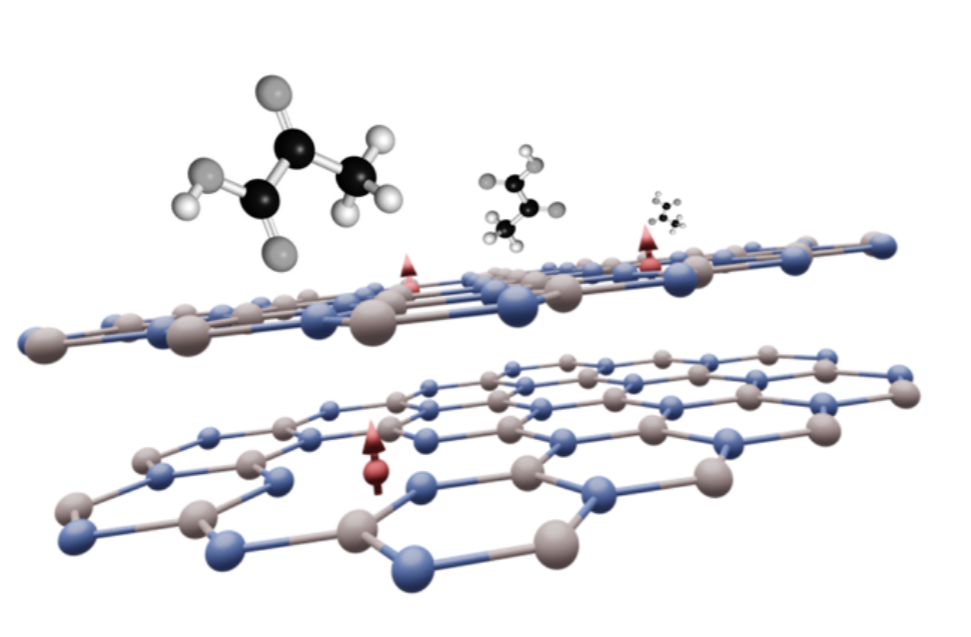
Hexagonal Boron Nitride (hBN)
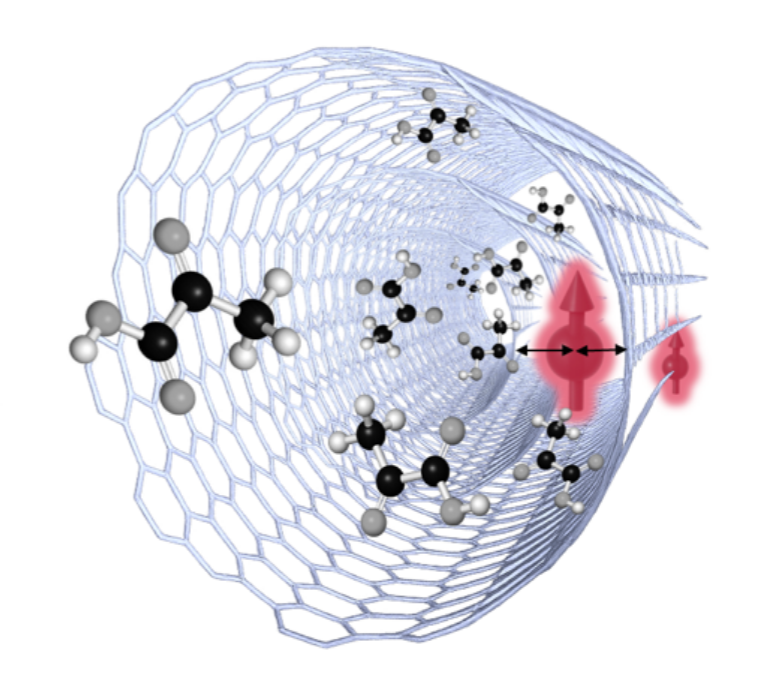
Boron Nitride Nanotubes (BNNTs)
References
-
Rizzato, R., Schalk, M., Mohr, S. et al. Extending the coherence of spin defects in hBN enables advanced qubit control and quantum sensing. Nat Commun 14, 5089 (2023).
doi: 10.1038/s41467-023-40473-w -
X. Gao, X., Vaidya, S., Dikshit, S. et al. Nanotube spin defects for omnidirectional magnetic field sensing. Nat Commun 15, 7697 (2024).
doi: 10.1038/s41467-024-51941-2 -
Robertson, I.O., Whitefield, B., Scholten, S.C. et al. A charge transfer mechanism for optically addressable solid-state spin pairs. Nat. Phys. 21, 1981–1987 (2025).
doi: 10.1038/s41567-025-03091-5 -
Rizzato, R., Hidalgo, A.A., Nie, L. et al. Quantum sensing with spin defects in boron nitride nanotubes. Nat Commun 16, 11333 (2025).
doi: 10.1038/s41467-025-67538-2